
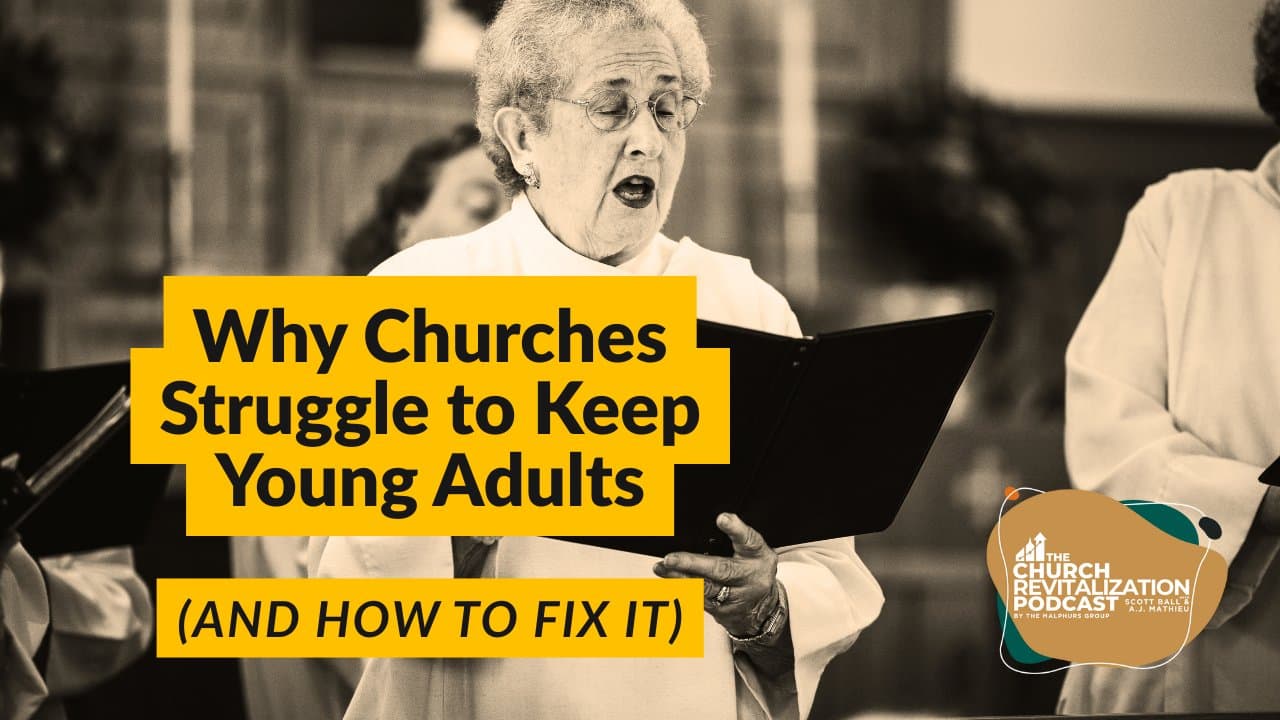
The Church Revitalization Podcast – Episode 326– Retaining Young Adults In Church
Many churches feel the tension. Young adults show up sporadically, drift away quietly, or never seem to connect at all. Leaders wonder why efforts that worked in the past no longer seem effective. Programs are offered, sermons are solid, and the church genuinely wants young adults to stay.
Yet retaining young adults in church remains a persistent challenge.
The issue is rarely about style, production value, or being culturally trendy. The real reasons run deeper. In most churches, young adults disengage for two core reasons, and both are within a church’s ability to address.


The Two Reasons Churches Lose Young Adults
Reason 1: No Real Responsibility
Many churches unintentionally treat young adults like extended teenagers. They are welcomed, but not trusted. Included, but not empowered.
This becomes especially visible when you consider how young adults function outside the church. A 25 or 28 year old may manage a team at work, oversee budgets, make decisions, and carry real responsibility every weekday. Then they arrive at church and are limited to helping roles with little influence or ownership.
Often, the pathway looks like this:
- A “college and career” class with no next step
- Serving opportunities that never progress beyond basic tasks
- Leadership spaces that feel closed until some undefined future stage of life
When capable adults are not given meaningful responsibility, they eventually conclude that their contributions are not valued. Retaining young adults in church becomes difficult when leadership is something they are asked to wait for indefinitely rather than grow into intentionally.
This does not mean every young adult should hold a high-level position. It does mean they should see a clear on-ramp toward leadership that matches their maturity, gifting, and experience.
Reason 2: No Real Community
For many young adults, Sunday morning feels like an event rather than a relational space. They attend a service, exchange polite greetings, and leave without meaningful connection.
Even when churches offer small groups, young adults often find themselves surrounded by people decades older than them, with little opportunity to form peer relationships. While intergenerational community is healthy, it requires intentional effort to move beyond surface-level interaction.
When real community is absent, young adults look elsewhere. They find connection through work, friendships, hobbies, service projects, or informal gatherings. If the church offers programs but not people, it struggles to compete with spaces where relationships form naturally.
Retaining young adults in church requires more than scheduling activities. It requires environments where belonging develops through shared life, not just shared attendance.
Three Fixes Churches Can Start This Week
The good news is that these challenges are not abstract or theoretical. There are practical steps churches can take right now to create conditions where young adults stay and thrive.
Fix 1: Give Them Real Leadership
Start by identifying five to ten young adults who already demonstrate character, commitment, and competence. These may be people already attending your church or, in some cases, trusted leaders recommended from nearby churches.
Within the next 90 days, give them real responsibility. Not symbolic roles. Not endless preparation. Real leadership with clear expectations and real ownership.
This can include:
- Leading a ministry area
- Serving on a committee with budget authority
- Taking responsibility for planning, decision-making, or discipleship initiatives
The goal is not perfection. The goal is trust. When young adults are allowed to lead, not just help, they begin to see the church as a place where their gifts matter.
This alone can significantly improve retaining young adults in church because it communicates belief, respect, and investment.
Fix 2: Build Natural Connection Points
Many churches respond to disengagement by creating more programs. Often, the better approach is creating consistent times and spaces where relationships can form naturally.
Instead of adding complexity, focus on simplicity and rhythm:
- Weekly dinners or shared meals
- A regular Sunday lunch group
- Monthly service projects that involve working side by side
These environments allow conversation to happen organically. They remove pressure, reduce formality, and make space for genuine connection.
It is also important to evaluate timing. Are gatherings scheduled in ways that fit the rhythms of working young adults, or are they designed primarily around retired schedules? Accessibility matters.
Community forms best when people are doing life together, not just attending structured meetings.
Fix 3: Ask Them What to Change
One of the most overlooked strategies for retaining young adults in church is simply asking for their input and taking it seriously.
This week, schedule coffee or a meal with three young adults. Keep it casual and relational. Ask three simple questions:
- What makes you want to stay here?
- What almost makes you leave?
- If you could change one thing, what would it be?
Then listen without defending, correcting, or explaining. The goal is understanding, not persuasion.
Finally, close the loop. Within 30 days, communicate what you are actually changing as a result of those conversations. When young adults see their input valued and acted upon, trust grows. Engagement deepens. Retention follows.
Young Adults Are Not the Future of the Church
They are the present.
Churches that succeed in retaining young adults in church do not do so by chasing trends. They do so by offering responsibility, fostering authentic community, and listening with humility.
These changes do not require massive budgets or sweeping overhauls. They require intentional leadership and a willingness to see young adults not as a problem to solve, but as partners in the mission today.
Small steps, taken consistently, can change the trajectory of an entire generation within your church.
Also check out:
Youth are the Future of the Church
Watch this episode on YouTube!


A.J. Mathieu is the President of the Malphurs Group. He is passionate about helping churches thrive and travels internationally to teach and train pastors to lead healthy disciple-making churches. A.J. lives in the Ft. Worth, Texas area, enjoys the outdoors, and loves spending time with his wife and two sons. Click here to email A.J.
