
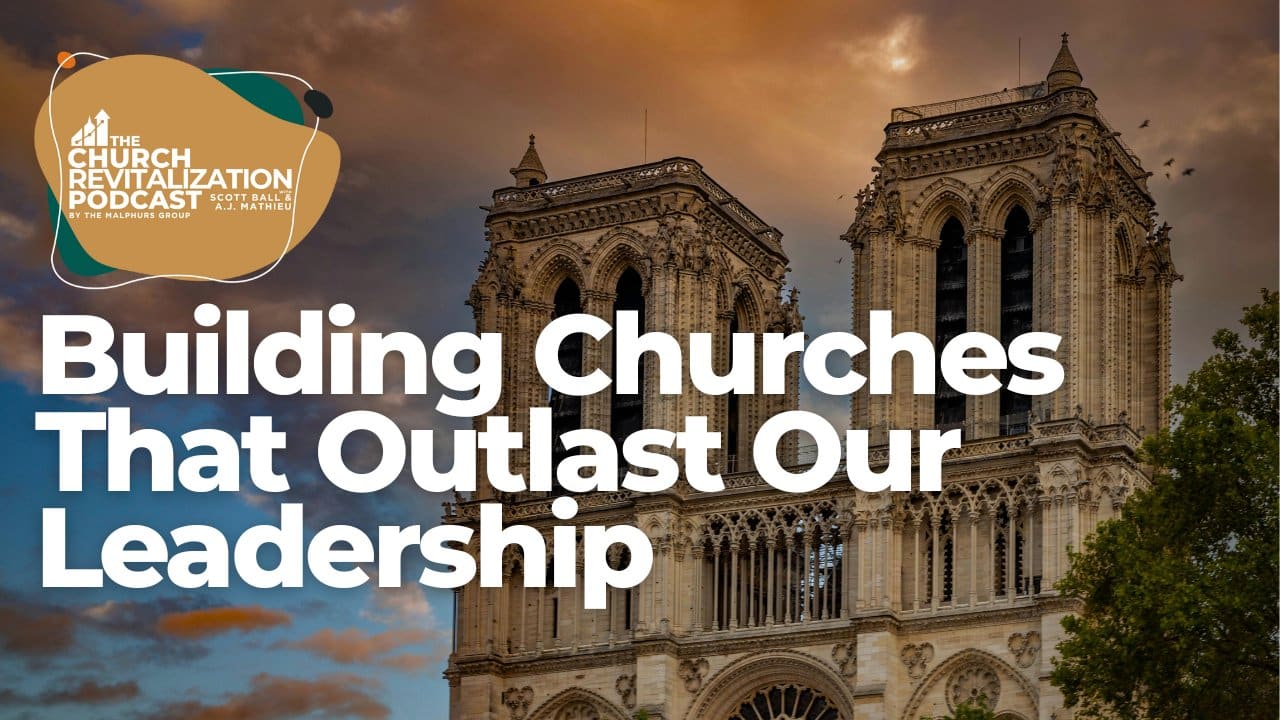
The Church Revitalization Podcast - Episode 328- Building a Church That Lasts
Most churches are not designed to survive the pastor who built them. That is a hard truth, but it is one worth sitting with. When a long-tenured pastor retires, resigns, or passes away, the church they built often enters a period of identity crisis. Attendance drops. Staff morale falters. The congregation wonders who they are without the person who defined them for so long. A new pastor arrives and feels pressure to either clone the previous leader or tear everything down and start over. Then the cycle repeats.
Building a church that lasts requires more than a great leader. It requires a different way of thinking about leadership itself. That shift does not begin the day a pastor announces a departure. It begins years or even decades earlier, in the quiet decisions a leader makes about how to build.
There is a lesson worth learning from an unlikely source: the great medieval cathedrals of Europe.
What Cathedral Builders Understood About Building Something That Lasts
Consider Notre-Dame de Paris. Construction began around 1163 and was not substantially complete until the mid-1200s, spanning more than a century of work. During that time, France experienced wars, plagues, economic crises, and the reign of multiple kings. Master builders came and went. And yet the project remained coherent. The vision held. The work continued.
What made that possible? The builders did not assume that any single person would finish the project. They planned for succession from the beginning. Systems were built for passing knowledge forward. They anchored the work to something bigger than any one individual's personality or preferences.
Modern churches rarely operate this way. Instead, they build around a leader and hope for the best. When that leader leaves, the cracks appear almost immediately. Building a church that lasts means planning from the outset for the leader who comes next, and the one after that.
Here are three lessons from the cathedral builders that every pastor and church leader should take seriously.
Lesson 1: The Mission Must Be Bigger Than Your Personality
Cathedral builders agreed on what they were constructing and why. They did not need to reinvent the purpose of the project with each new master builder. The theological vision that drove the work was shared, documented in the design itself, and handed from one generation of craftsmen to the next.
The same principle applies in the local church. Your mission predates you. The Great Commission was given long before you arrived at your church, and it will continue long after you are gone. The question is whether your congregation understands the mission as something that belongs to Christ and the church, or whether they experience it as something that belongs to you.
Ask yourself some honest questions. Could the next pastor of your church explain your mission in the same way you do? Are the values of your church written down in a way that someone new could actually lead from, or do they exist mostly in your head and in the informal culture you have created? Is your ministry strategy built around your particular gifts and personality, or is it built around a clear discipleship process that could function under different leadership?
A helpful test is this: could a qualified stranger read your church's documents and lead your congregation faithfully? If the honest answer is no, then you have built around yourself rather than around the mission. That is not a moral failing, but it is a leadership problem that needs to be addressed before a transition forces the issue.
Building a church that lasts means rooting your church's identity so deeply in its theology and mission that a leadership transition does not require a complete reinvention. New leaders should be able to step into a clear framework rather than starting from scratch.
Lesson 2: Stop Being the Bottleneck
Medieval cathedrals were not built by lone geniuses. They were built through robust guild systems and apprenticeship models. Knowledge was distributed. Skills were passed on. The work of laying stone, carving facades, and engineering vaulted ceilings was understood not just by the master builder but by the teams of craftsmen who worked alongside him. No single person was indispensable.
Many churches today are structured in the exact opposite way. The pastor is the one who knows why key decisions were made. He is the one who understands how systems work. He's the one who can cast vision in a way that motivates the congregation. Everything flows through one person, and that creates profound fragility.
Think about what would happen if you took three weeks away from your church with no access to email or phone. How many decisions could your staff and elders make confidently without you? How many things would simply stall because the right person was not available to weigh in? If the honest answer is that most things would stall, then your church has a bottleneck problem, and that bottleneck is you.
This is not a criticism of pastoral authority or vision. It is a call to lead differently. Distributed leadership is not leaderless leadership. It is the kind of leadership that develops other leaders rather than creating dependency.
Practically, this means documenting the reasoning behind your key decisions, not just the decisions themselves. It means developing leaders around you who can make real decisions in your absence, not just carry out instructions. It means building systems that can function when you are not present. And it means treating the development of the next generation of leaders as a core pastoral responsibility rather than a nice-to-have.
Paul modeled this throughout his ministry. His letters mention a long list of people he was bringing alongside him, training them in how to plant churches, lead communities, and handle conflict. The church exists today in part because Paul was not content to be the only one who knew how things worked.
The same question applies to every pastor: who are you raising up, and do they have enough real responsibility to actually be ready when the time comes?
Lesson 3: Think Generationally, Not Just Annually
The cathedral builders knew from the beginning that they would not see the project completed. They built anyway. They made decisions that would serve generations of builders who would come after them, and they trusted that the work would eventually be finished by people they would never meet.
Most church leadership operates on a much shorter timeline. Annual budgets, seasonal attendance campaigns, and fiscal year goals shape how leaders think and plan. There is nothing inherently wrong with short-term planning, but when it becomes the only lens through which a church evaluates its health, it leads to a dangerous form of optimization.
A church can be growing in attendance while simultaneously becoming more fragile. It can be winning every short-term metric while quietly drifting toward a leadership crisis no one is prepared for. The question that rarely gets asked is this: what will this church look like ten years after I am gone?
That question reorients everything. It shifts the frame from "what can I accomplish during my tenure" to "what foundation am I laying for whoever comes next." It moves the goal from leaving a legacy to being a faithful steward. And it produces a different kind of leader, one who is more interested in building up the people around them than in ensuring their own visibility.
This kind of generational thinking is not passive. It is active and intentional. Just as each new master builder of a cathedral was responsible for advancing the project further than they found it, each pastor is responsible for moving the mission forward. Building a church that lasts means asking not just what you can accomplish, but what you can put in place for the person who follows you.
Second Timothy 2:2 captures this well: "And what you have heard from me in the presence of many witnesses, entrust to faithful men who will be able to teach others also." This is not just a principle for individual discipleship. It is the operating logic of a generational church.
Three Actions to Take This Quarter
Understanding the cathedral model is one thing. Applying it requires some concrete steps. Here are three actions that can move any church toward greater long-term health.
Audit your bottlenecks. Make a list of everything that only you can do in your church. Be specific. Then identify at least one critical item on that list and begin intentionally training someone else to handle it. Do not wait until a transition is imminent. Start now.
Document your why. Write down the theology and reasoning behind your most important decisions and practices. Create a document that captures what the next pastor would need to know to lead your church faithfully. This is not a task that takes a single afternoon, but getting started puts something in place that protects your congregation for years to come.
Test your systems. Use your next vacation or extended absence as a low-key experiment. Rather than spending hours briefing your team before you leave, step back and see what happens. When you return, take note of what worked, what stalled, and what required more preparation than it should have. Those gaps are your renovation list.
A Different Kind of Legacy
There is something humbling about the cathedral mindset. The people who laid the foundations of Notre-Dame never worshiped inside the finished nave. They built for people they would never meet, driven by a vision that was bigger than their own contribution to it.
That is the posture every church leader is called to hold. You are not building a monument to your ministry. You are stewarding a mission that started long before you arrived and will continue long after you leave. Building a church that lasts is less about your gifts and more about your faithfulness as a steward of something that belongs to God.
Your church's health ten years after you leave matters more than your attendance numbers while you are there. That is a challenging standard, but it is the right one.
If you are looking for tools to help your church build for the long haul, the Healthy Churches Toolkit is a practical starting point. It is a church leadership operating system that includes training, planning tools, and resources designed to help your team lead well together across every season of ministry. You can try it free for seven days at healthychurchestoolkit.com.
Build for the next generation, not just the next quarter.
Watch this episode on YouTube!
