
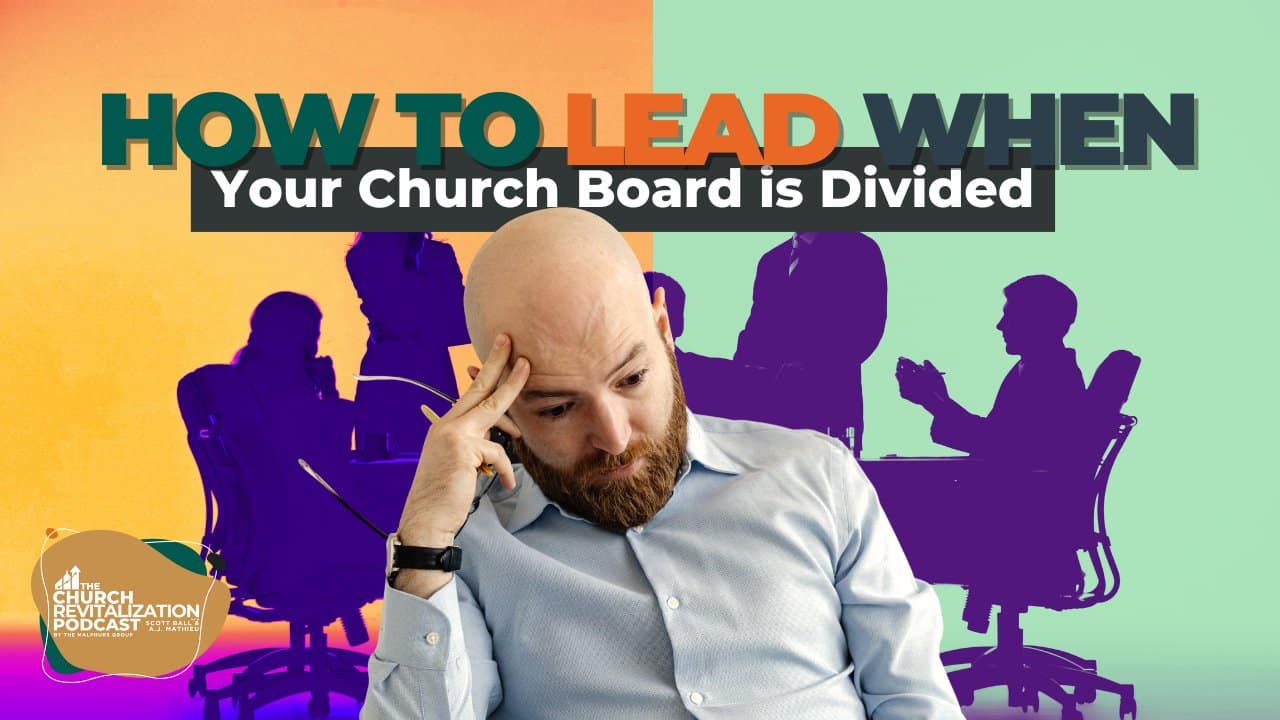
The Church Revitalization Podcast - Episode 324- Church Board Division
Board meetings should move your church forward, not leave everyone stuck in gridlock. When church board division takes over your leadership team, every decision becomes a battle and momentum dies. Whether you're facing an elder board standoff, a deacon team dispute, or staff leadership conflict, understanding how to navigate division is critical to your effectiveness as a leader.
The reality is that church board division comes in different forms, requires different responses, and can be prevented with the right structures in place. Leading through disagreement doesn't mean getting everyone to agree on everything. It means diagnosing the real problem, making wise decisions, and calling your team to unity around a shared direction.


Diagnose the Type of Church Board Division You're Facing
Not all church board division is the same. Before you can resolve conflict on your leadership team, you need to understand what kind of division you're actually dealing with. There are two distinct types of division that require completely different leadership responses.
Directional Division: Disagreement About Where to Go
Directional division happens when your board disagrees about strategy, priorities, or the path forward. This might look like debating whether to launch a second service or invest in small groups, disagreeing about budget allocations, or having different views on hiring decisions.
This type of church board division is actually healthy tension. It means people care enough to engage with important questions and think critically about what's best for the church. Your job as a leader isn't to eliminate this kind of disagreement. Your job is to facilitate a good decision and then call the team to unity around that decision.
The challenge with directional division is that it often reveals deeper misalignment on foundational issues. You might think you're arguing about whether to emphasize evangelism in your discipleship pathway, only to discover that half your board sees the Great Commandment as your mission while the other half focuses on the Great Commission. You can't resolve disagreements about strategy when you haven't established unity on mission.
This is why starting with the most foundational questions matters so much. When you confirm agreement on mission, values, and philosophy of ministry first, you create a framework for making directional decisions later. Without that foundation, every strategic conversation becomes a referendum on competing visions for the church.
Relational Division: Personal Conflict Between Board Members
Relational division is fundamentally different. This happens when board members have personal conflict that colors every interaction. Maybe two elders had a falling out over a previous decision and never resolved it. Perhaps there's a personality clash that makes collaboration difficult. Sometimes the issue is deeper, where someone simply doesn't respect or trust another board member.
This type of church board division is toxic because it sabotages everything else. When relational conflict exists, people express their personal grievances through directional language. The disagreement sounds like it's about budget priorities or staffing decisions, but it's really about unresolved interpersonal issues.
Your job as a leader is to address relational division directly. It won't resolve itself, and it will poison every other decision your board tries to make. This requires honest conversations, often one on one, where you name what you're observing and create space for reconciliation. Sometimes you need to bring in an objective third party who can help navigate the conflict without the baggage of existing relationships.
The key to leading through church board division is stopping the practice of treating every disagreement the same way. Directional tension needs facilitation and decision making. Relational toxicity needs confrontation and resolution. When you misdiagnose the problem, you apply the wrong solution and the division persists.
Lead to a Decision Without Requiring Unanimity
Here's a truth many pastors struggle to accept: your job isn't to get everyone on your board to agree. Your job is to make a wise decision and call the team to unity around it. Church board division often persists because leaders confuse unity with unanimity.
Unity means everyone commits to supporting the decision once it's made, even if it wasn't their preferred option. Unanimity means everyone agrees with the decision. Unanimity is wonderful when it happens naturally, but requiring it as a standard for every decision creates paralysis. When one or two people can hold up any decision indefinitely by refusing to agree, you've given veto power to those least aligned with where the church needs to go.
The biblical example in Acts 15 shows us a better way. The early church leaders had serious disagreement about whether Gentile believers needed to follow Jewish law. They didn't paper over their differences or wait until everyone naturally agreed. They worked through the disagreement together, made a decision, and moved forward in unity. The process involved honest dialogue, listening to different perspectives, and ultimately making a choice that the whole group could support.
Three Leadership Moves for Resolving Church Board Division
When you're facing directional division on your board, three specific leadership actions can help you move from gridlock to decision.
First, name the real issue clearly. Stop dancing around what you're actually disagreeing about. Many boards waste time debating surface level questions when the real disagreement is deeper. If you're stuck on whether to hire a worship pastor, the actual issue might be differing philosophies about what Sunday morning gatherings should accomplish. Get to the heart of the matter so you can address it directly.
Second, set a decision deadline. Open ended conflict kills momentum and creates opportunity for division to spread beyond the boardroom. When you establish a clear timeline for making a decision, you create urgency and focus. This doesn't mean rushing into poor decisions, but it does mean refusing to let important questions linger indefinitely.
Third, define what unity means before you make the decision. Have an explicit conversation about expectations: "We don't all have to agree with the final decision, but we all need to commit to supporting it once it's made. Can everyone here do that?" This clarifies the standard and helps you identify whether you actually have directional division or a character problem.
Recognize When Division Reveals Character Issues
Here's the hard truth about church board division: if someone can't commit to unity after a decision is made, you don't have a disagreement problem. You have a character problem. Leadership requires the ability to advocate for your position, listen to others, participate in a decision making process, and then support the outcome even when it's not what you wanted.
Board members who undermine decisions after they're made, speak negatively about choices they participated in, or stir up division in the congregation reveal a fundamental unfitness for leadership. It would be better to not make a decision at all than to have board members actively work against what the team decided together.
This is why defining expectations about unity matters so much. When you've established that commitment to support decisions is non negotiable, and someone reveals they can't or won't do that, you have clarity. The issue isn't the decision itself. The issue is whether this person should continue serving in leadership.
Prevent Church Board Division by Clarifying Authority Before Conflict
The best time to resolve questions about decision making authority is when things are calm, not when you're in the middle of a heated disagreement. Most church board division gets worse because no one knows who actually has the authority to make various decisions until conflict forces the question.
Churches often operate on tradition and assumed understanding rather than clear, written policies. The constitution says one thing, but no one remembers it ever functioning that way. Or the bylaws are vague about who decides what, leaving room for interpretation when disagreement arises. This ambiguity creates fertile ground for division.
Every church member becomes an expert in the constitution when there's conflict. People who haven't thought about governance documents in years suddenly demand strict adherence to every clause. This reveals the problem: if your governing documents only matter during fights, they're not actually governing your church in healthy times.
Three Questions Every Church Board Should Answer
Preventing church board division requires clarity on three fundamental questions about authority and decision making.
First, what decisions does the board make versus what decisions does the pastor make? Some churches give their boards too much authority over operational details, creating bottlenecks and frustration. Other churches leave boards unclear about their role, leading to confusion about what they're actually responsible for. Defining these boundaries clearly helps everyone understand their lane.
Second, when do you need full board consensus versus a simple majority? Not every decision requires the same level of agreement. Some choices are significant enough that you want broad support before moving forward. Others can be made with majority support and clear expectations that everyone will unite behind the decision. Clarifying these categories in advance prevents arguments about process in the moment.
Third, what happens when you disagree? This seems obvious, but many boards have never explicitly discussed their conflict resolution process. When disagreement happens, who facilitates? What does healthy disagreement look like? How do you escalate if you can't reach resolution? Answering these questions before conflict arises gives you a roadmap when tensions increase.
Put Your Governance in Writing
Whatever you decide about authority and decision making needs to be documented. This isn't about creating bureaucracy or legalism. It's about providing clarity that protects everyone involved. When expectations are clear and written down, people can operate with confidence. When they're vague or only verbal, people operate with assumption and misunderstanding.
Include these governance clarifications in your board member onboarding process. Don't assume that because something is written down, everyone knows it. Review your governance documents annually with your full board. This keeps everyone aligned and provides opportunity to update policies as your church grows and changes.
Many churches discover that their written governance documents don't match how they actually function. This creates risk and confusion. If your constitution designates specific times for worship services but you're meeting at different times, you need to update the constitution. If your bylaws give authority to groups that no longer exist, you need to revise them. Align your written policies with your actual practice, or change your practice to match your policies.
Build Relationships Outside Board Meetings
One final practice can dramatically reduce church board division: have regular one on one conversations with board members between meetings. Most division gets worse because pastors only interact with their board in group settings. When someone disagrees in a board meeting, it often catches the pastor off guard because there's been no prior conversation.
Individual conversations create space for board members to process questions, express concerns, and think through decisions without the pressure of a group dynamic. You can gauge where people are, address misunderstandings before they become public disagreements, and build the relational trust that makes healthy conflict possible.
These conversations also help you distinguish between directional and relational division. If someone consistently disagrees with everything in board meetings but seems reasonable in one on one conversations, you might be seeing a group dynamic problem. If the disagreement persists across both settings, you're dealing with genuine directional differences that need to be addressed.
Moving Forward Through Church Board Division
Leadership teams will always have disagreements. The question isn't whether your board will experience division, but whether you'll lead through it effectively. When you diagnose the type of division accurately, lead decisively without requiring unanimity, and establish clear authority structures before conflict arises, you create the conditions for healthy leadership.
Church board division doesn't have to paralyze your church. With the right approach, disagreement can sharpen your thinking, expose important questions, and ultimately lead to better decisions. Your job is to create the environment where healthy tension leads to wise choices and where unhealthy conflict gets addressed before it poisons everything else.
The church depends on leadership teams that can work through disagreement and move forward together. When you stop treating every disagreement the same way, define what unity really means, and clarify decision making authority in advance, you equip your board to lead effectively even when they don't all see things the same way.
Additional Resources:
How to Recruit a Healthy Church Board
5 Dysfunctional Habits of Unhealthy Church Boards
Watch this episode on YouTube!


Scott Ball is the Vice President and a Lead Guide with The Malphurs Group. He lives in East Tennessee with his wife and two children. (Email Scott).
