
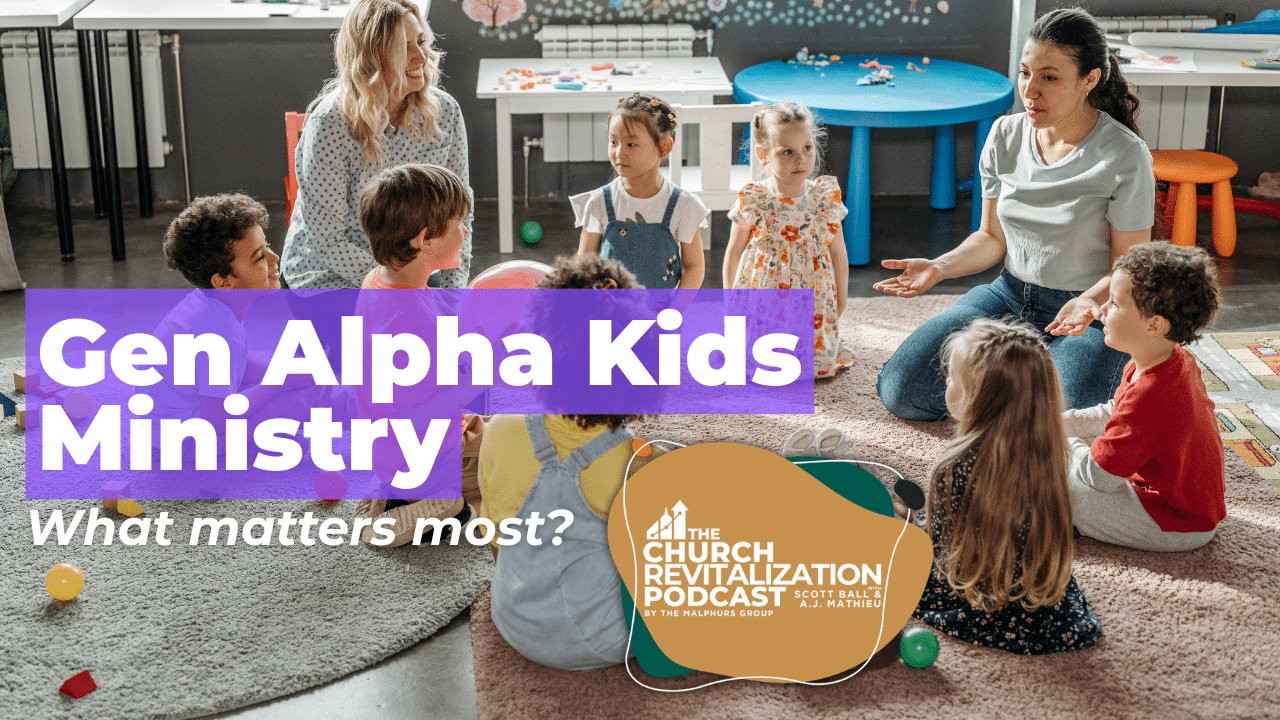
The Church Revitalization Podcast - Episode 348 - Gen Alpha Kids Ministry
The children sitting in your classrooms right now are Gen Alpha, born between 2010 and 2024, and they are the most screen-saturated, digitally immersed generation in history. Their parents are Millennials, and Millennials do not show up passively. They research before they visit, they evaluate what they find, and when something falls short, they leave without saying a word. A Gen Alpha kids ministry that runs on outdated assumptions will lose these families quietly, often before a second visit ever happens. The good news: the shifts required are less about budget and more about intentionality. Here are three changes your church can make now.


Your Communication with Parents Has a Discipleship Problem
Millennial parents expect proactive communication, digital-first but not digital-only. That distinction matters more than most church leaders realize. A weekly app push or text message covering three conversation starters from Sunday's lesson costs almost nothing. A volunteer-recorded one-minute video recap takes maybe ten minutes to produce. A redesigned take-home card, one written for the parent rather than the child, can go home every single week.
But here is the question worth sitting with: if a parent wanted to continue Sunday's lesson at the dinner table tonight, could they? If the answer is no, your church has a discipleship gap, not just a communication gap. You have handed the baton to no one.
Millennial parents are overwhelmed. They are not asking for more volume of information. They want the right information at the right moment, formatted so they can actually use it. When your kids ministry makes that easy, parents stop feeling like Sunday is a drop-off event and start seeing themselves as partners in what God is doing in their child's life. That is a win for the family and for your church's long-term retention.
Printed materials still matter. A paper that a child physically hands to a parent in the car ride home creates a moment that no push notification can replicate. Back it up digitally, yes, but do not abandon the tangible.
Your Check-In System Is Sending a Message Whether You Know It or Not
Gen Alpha parents grew up in a post-Columbine world. Safety is not a preference for them; it is a baseline filter they apply to every institution their child enters. When a first-time Millennial parent walks into a kids ministry and finds a clipboard, a hallway with no clear direction, and a volunteer who says "oh, we know everybody here," they hear something specific: this place is not prepared.
Upgrading your check-in does not require an expensive overhaul. Inexpensive software options exist for churches of every size. What matters more than the technology, though, is having a real process that people actually follow every week, without exception.
One thing worth naming directly: safety failures rarely happen with the new kid. They happen with children who are considered "known," and with families or volunteers who have been around long enough that the protocol gets relaxed around them. Long-term attenders with Gen Alpha children are watching this too. They notice when the rules apply selectively.
Background checks, two-adult rules in every room, allergy protocols posted clearly, and documented volunteer training are all visible trust signals. They tell a visiting parent that your church takes responsibility seriously. Beyond that, your safety culture communicates your organizational culture. A chaotic kids wing signals a chaotic church, even if that impression is completely unfair to every other ministry you run.
Tech Expectations in the Classroom Have Shifted, and the Fix Is Simpler Than You Think
Gen Alpha kids have grown up with YouTube, interactive tablets, and voice-activated devices. A flannel board is not going to hold their attention, and neither is a lesson that runs like a lecture. That said, this is not a call to blow your A/V budget on LED walls and fog machines.
The real shift is from passive to participatory. Gen Alpha children learn by doing. Call-and-response teaching moments, hands-on activities, motion backgrounds on an inexpensive screen, and video curriculum (much of which is free or low-cost) can transform the feel of a kids classroom without a major financial investment. The style of teaching matters as much as the tools.
Here is the caution for leaders: do not let the technology conversation crowd out the factors that matter more. Your adult-to-child ratio and the quality of your volunteer team will always outperform whatever is on the screen. A trained, engaged adult who gets down on a child's level and knows their name is more compelling to a Gen Alpha kid than any production value you can create.
Experiential learning also aligns naturally with biblical discipleship models. The shift away from lecture-style teaching is not a concession to culture; it is a return to how formation has always worked best.
Reaching Gen Alpha Kids Is Your Best Strategy for Reaching Millennial Parents
Senior pastors need to hear this point clearly. Your kids ministry is not a cost center. It is your front door to an entire generation of Millennial families, many of whom carry wounds from church experiences in their own childhood. They are not looking for a reason to come back. But their child might give them one.
A child who loves Sunday morning becomes a weekly advocate inside the home. That child asks to go back and talks about what they learned. That child creates a pull that no sermon series, no mailer, and no social media campaign can manufacture from the outside. That is organic, household-level evangelism.
When a Millennial parent who drifted from faith watches their child come alive in a church environment, something opens. The walls they built around organized religion start to shift. Your kids ministry is doing pre-evangelism work on the parents every single week, whether your leadership team recognizes it or not.
The budget conversation around kids ministry changes entirely when you frame it this way. Ask your leadership team: are we investing in kids ministry at a level that reflects its actual strategic importance to our mission?
Three Things You Can Do This Week Without Spending a Dollar
Practical action does not have to wait for a budget cycle or a strategy retreat. Here are three moves any church can make immediately.
- Do a first-time parent walkthrough. Walk through your kids check-in and classroom experience as if you have never been there before. Write down everything that confused or concerned you. That list is your improvement roadmap.
- Send one useful parent communication this Sunday. Include three specific conversation starters based on what the children learned. Make it short. Make it usable at the dinner table that night.
- Have an honest team conversation. Gather your kids ministry volunteers and leaders and ask: what do we actually know about what Gen Alpha children and their Millennial parents expect? Then look honestly at the gap between that answer and what you are currently delivering.
The families God wants to reach through your church are already out there. Gen Alpha kids and their Millennial parents represent a wide-open opportunity for churches willing to meet them where they are. Do not let an outdated ministry model be the thing that closes the door before it ever fully opens.
For practical tools to strengthen every ministry in your church, visit healthychurchestoolkit.com and start a free seven-day trial. To explore how The Malphurs Group can help your church develop a stronger ministry strategy, visit malphursgroup.com.
Also check out:
How to Attract Young Families to Your Aging Church: 5 Proven Strategies
Four Questions Young Families Ask When Looking for a Church
Watch this episode on YouTube!


Scott Ball is the Vice President and a Lead Guide with The Malphurs Group. He lives in East Tennessee with his wife and two children. (Email Scott).
