
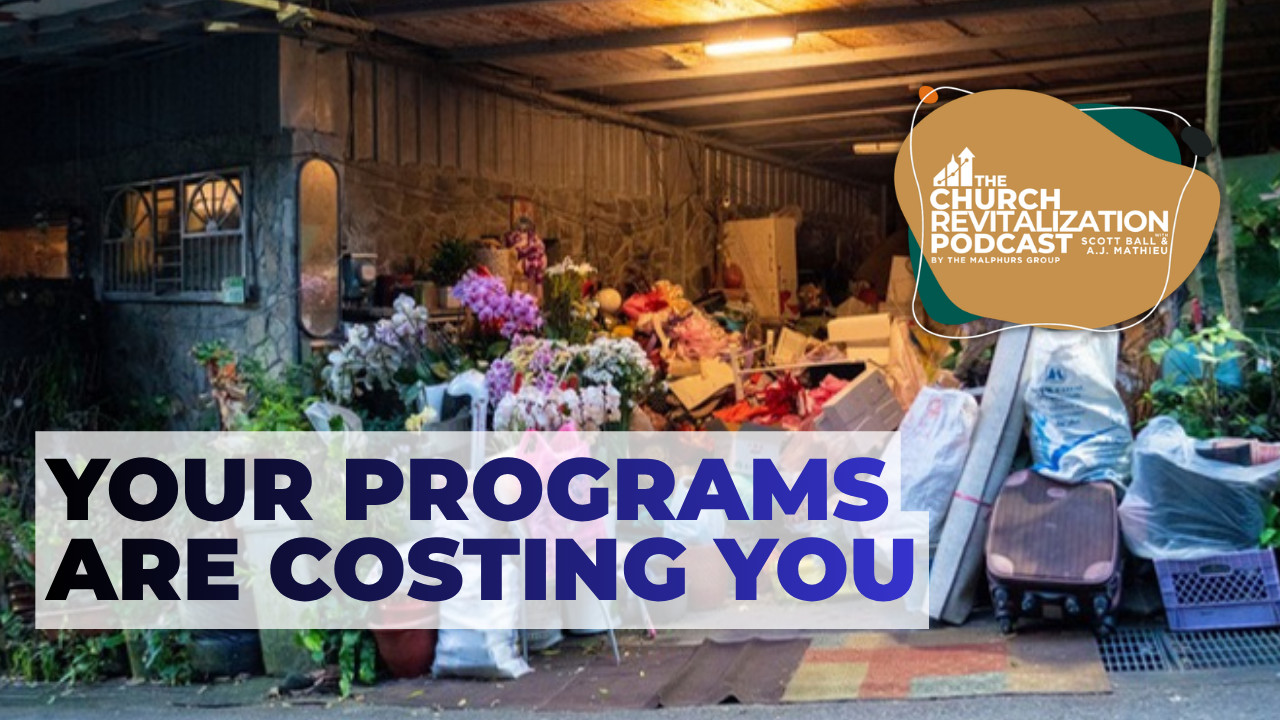
The Church Revitalization Podcast - Episode 366 - Church Program Audit
You Cannot Grow What You Are Too Busy Maintaining
A church program audit is one of the most avoided leadership conversations in ministry. Not because pastors lack courage, but because every program on the calendar started with someone's real vision, real prayer, and real effort. Cutting a ministry or an event feels like cutting people. So most churches never do it, and the calendar just keeps growing, year after year, until the ministry schedule looks less like a strategy and more like a museum.
Here is the uncomfortable truth: a church with a volunteer shortage often does not need more people. It needs fewer programs. Complexity is quietly consuming the capacity your church needs to actually move people toward Christ. The good news is that a thoughtful audit can fix this, and it does not have to destroy relationships in the process.
Why Legacy Programs Are a Hidden Volunteer Tax
The word "free" is relative. A ministry that costs nothing in the budget can still cost your church enormously in volunteer hours, attention, and energy. Consider a ministry like a monthly knitting group that donates blankets to a local hospital. No line item. No budget. Seemingly harmless. But the volunteer who runs it has mentally allocated that time to her ministry commitment bucket. When you ask her to help with children's ministry check-in, her answer is shaped by that prior commitment, even if the actual hours are modest.
This is what makes legacy programs so costly. It is not just the hours they consume. It is the perception they create. Volunteers do not run a detailed time audit before they say yes or no to something new. They run a quick mental check of the blob, the general sense of how committed they already are. If the blob feels full, the answer is no. Every program on your calendar, weekly, monthly, or just three times a year, contributes to that blob.
Even events that happen only a few times annually carry hidden weight. The event itself is one day, but the preparation starts weeks earlier. Volunteers attend planning meetings, build materials, and coordinate logistics long before the actual date. Multiply that across several events and you have consumed a significant portion of your volunteer capacity on things that may have little connection to your discipleship goals.
How to Run a Church Program Audit Before the New Year
A church program audit does not require a consultant or a retreat. Start with something simple: pull your ministry calendar from the last twelve months and list everything that required volunteer coordination. Weekly programs, monthly gatherings, quarterly events, one-time initiatives. Put it all on one page. For most church leaders, that moment alone is clarifying. The sheer volume is often surprising.
Once you have the list, run each item through two honest questions. First, does this program move people along your discipleship pathway? Second, does it produce enough discipleship fruit to justify the volunteer energy it requires? Programs that score low on both questions are candidates for elimination or consolidation, not more investment.
One important caveat: do not go through this list alone. Pull together a small team of staff and key volunteers. You will consistently find that one person in the room knows something about a ministry that everyone else has forgotten. A program that looks expendable from one angle might be your best outreach touchpoint from another. Good input produces good output. The goal is not to cut indiscriminately. The goal is to cut intentionally.
If you work through this exercise and realize the clutter is deeper than a few items, that is a signal that a more comprehensive process is needed. At that point, connecting with a Malphurs Group Certified Guide for a full Strategic Envisioning process is worth serious consideration. Reach out at https://malphursgroup.com.
The Two Questions Every Program Must Be Able to Answer
A ministry audit only works if you have something to measure against. That means your church needs a defined discipleship pathway, a clear picture of what a maturing disciple looks like and what steps move someone in that direction. Without that baseline, you cannot evaluate whether a program is producing anything meaningful. You are just guessing.
When you apply the two audit questions to your calendar, the goal is integration, not minimalism. The point is not to have fewer programs for the sake of fewer programs. The point is to have programs that work together in a coordinated way to produce a discipleship outcome. If a program does not connect to that outcome, it is not a strategy. It is activity dressed up as ministry.
Some programs will surprise you. A small group that looks low-attendance on paper might be producing meaningful spiritual growth and strong community. Another program that draws a crowd might be generating activity without producing disciples. Attendance and energy are not the same as fruit. Your audit questions cut through the noise and get to what actually matters.
How to End a Program Without Ending Relationships
Most pastors already know which programs need to go. The delay is never really strategic. It is relational. Someone started this ministry. There may still be someone who loves it, and they may be upset if it ends. That is a real concern, and it deserves a real response.
Two approaches work well in practice. The first is a clear runway. If a program needs to end, announce it honestly and give it a dignified close. Tell the people involved what it accomplished, set a clear end date, and personally invite them into a role with greater impact. Frame it as a graduation, not a cancellation. This program served its season well. The church is now directing its energy toward something with higher mission return, and the people who led this program are exactly who you want leading what comes next.
The second approach is sunsetting. Rather than a formal announcement, you first communicate with those involved and then stop promoting the program. It stays off the bulletin, off the church calendar, and out of the announcements. Volunteers who want to continue can do so informally. But the church is no longer recruiting for it, communicating about it, or treating it as an official ministry. This removes the attention tax and the volunteer tax without requiring a more difficult conversation about cancellation. In many cases, the program winds down on its own within a few months through natural attrition. The fear of fallout is almost always larger than the actual result.
One pastor working through this process with his church was convinced that cutting the motorcycle ministry would cause a revolt. He told the group they could keep meeting but that the church would no longer promote it. Within three months, it was gone. No one left. No one was angry. The perceived relational cost had been far greater than the real one.
Start Before December 31
A church program audit is not a once-a-decade project. It is an annual leadership responsibility. The end of the year is an ideal time to run it, before you lock in next year's calendar and simply copy the current one forward.
Before December 31, sit down with a small team and go through your last twelve months. Name the programs that are costing more than they are producing. Decide which ones get a runway, which ones get a sunset, and which ones deserve more investment. That is the work of a focused leadership team, not a committee that meets indefinitely.
If your church needs a full ministry overhaul, the team at The Malphurs Group can walk you through a comprehensive Strategic Envisioning process. Connect with a Certified Guide at https://malphursgroup.com.
For churches ready to manage the ongoing work of ministry planning, volunteer coordination, and strategic execution, the Healthy Churches Toolkit gives your team a practical operating system to keep everything aligned. Try it free for seven days at https://healthychurchestoolkit.com.
You cannot grow your mission while maintaining a museum. The audit starts now.
Also check out:
The Hidden Cost of Adding Too Many Church Ministries
Why Your Church Needs a Formal Review Process
3 Signs Your Church's Vision Has Expired
Three Fixes for Failing Strategies
Watch this episode on YouTube!

About Scott Ball
Vice President
Scott Ball is Vice President of The Malphurs Group, helping churches grow healthier disciples and equip more leaders. He and his wife Allison live in East Tennessee with their two kids.
