

The Church Revitalization Podcast - Episode 346 - Church Community Outreach
Church community outreach has always required courage, but the methods that once worked reliably are losing traction. The classic move, asking a neighbor or coworker to "come to church Sunday," still has its place. Yet for a growing number of unchurched people, walking into a worship service cold feels about as comfortable as showing up uninvited to a stranger's family dinner. The anxiety is real, and pastors who dismiss it are leaving people on the sidewalk who could have been reached through a different door. That different door is what this article is about.
The "side door" is any access point into your church's life and community that does not require a person to sit in a pew first. It is less formal, lower stakes, and far more relational. This is not a softening of the gospel or a retreat from evangelism. It is a missional posture that takes seriously where people actually are, not where we wish they were. Three practical side-door strategies follow below, and the best part: none of them require a big budget or a large staff.
Why the Sunday Invite Alone Is No Longer Enough
Fewer unchurched adults in America today have any meaningful frame of reference for what happens inside a worship service. The cultural memory of church, even nominal church attendance, has faded significantly over the past two decades. Post-pandemic, the gap widened further. People who drifted away during closures did not automatically drift back.
That means the Sunday morning service, as an entry point, now carries a steeper barrier than it once did. The person who has never attended, or who left years ago under painful circumstances, experiences real psychological resistance to walking through the front door. A viral Instagram reel of a nervous mother hyping herself up just to attend a single Sunday service captures this perfectly. She was not hostile to faith. She was intimidated by the unfamiliarity of the environment.
Side-door thinking acknowledges that barrier without conceding to it permanently. The goal is still to see people become followers of Christ and members of a local church community. The side door is simply the on-ramp, not the destination.
Side Door #1: Community Events That Serve First and Ask Nothing
The most common version of this strategy involves church-hosted community events, but there is a critical distinction between an event that genuinely serves people and one that functions as a thinly veiled recruitment pitch. Unchurched people can smell the difference immediately, and the manipulative version does more damage than no event at all.
A genuine community-serving event operates with one goal: meet a real need for the people in your area. Free community dinners, back-to-school supply giveaways, neighborhood cleanup days, ESL classes, financial literacy workshops, and food or clothing banks all qualify. The guiding principle is simple: no strings attached. The hot dog does not come with a required gospel presentation. The school supplies do not require filling out a commitment card.
This kind of generosity builds trust over time, and trust is what opens doors that a Sunday invite never could. When people in your zip code associate your church with the organization that showed up during a hard season and asked nothing in return, you have relational equity that no advertising campaign can manufacture.
A practical starting point: identify one felt need in your immediate community. Look at demographic data, talk to local school counselors or social workers, or simply pay attention to what your neighbors talk about. Build one annual or quarterly event around that need and do it consistently.
Side Door #2: Third-Place Presence
Sociologists use the term "third place" to describe the spaces in community life that are neither home nor work: coffee shops, parks, gyms, barber shops, neighborhood gathering spots. These are where real, unguarded relationships form. For many unchurched people, the third place is where they spend the most socially open hours of their week.
Church community outreach that ignores these spaces is outreach that operates entirely on church turf, on church terms, on the church's schedule. That approach requires unchurched people to come to you. Third-place presence flips that equation.
This strategy is less about programs and more about the posture of your people. A pastor who holds regular office hours at a local coffee shop is not running a program. A small group that meets in a neighborhood home instead of the church building is making a geographic and relational statement. A deacon who coaches Little League or joins the school's PTA is earning trust in environments where the church brand carries no automatic weight.
The side door here is personal relationship. People come to a church because they already know and trust someone from that church. The question worth asking at a leadership level is this: are we intentionally deploying our people into the community, or are we only gathering them on Sunday? Culture does not shift by accident. If you want your congregation dispersed into third places throughout the week, name it, celebrate it, and build accountability around it.
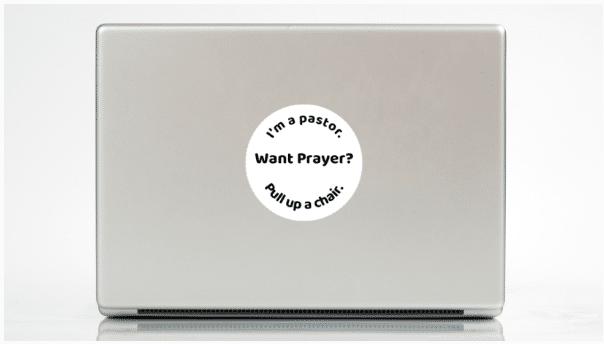
Get your Pastor Laptop Prayer Sticker today and have a conversation with someone tomorrow!
Side Door #3: Partnerships With Organizations Your Community Already Trusts
Churches do not have to build everything themselves. In fact, the impulse to launch a new ministry program for every community need is one of the more exhausting and counterproductive patterns in local church life. Your community already contains organizations doing excellent work, and many of them are open to genuine partnership.
Think about the institutions your neighbors already interact with and trust: public schools, food banks, crisis pregnancy centers, addiction recovery programs, after-school nonprofits. These organizations have relational access to people your church may never reach through its own programming. A partnership that serves their mission extends your church's presence without requiring you to run a new program from scratch.
The key distinction is that this kind of partnership should be genuinely kingdom-minded, not a branding exercise. Your logo does not need to be on every flyer. The relationship between your congregation and a local elementary school, built through consistent tutoring volunteers, teacher appreciation events, and supply drives, will produce organic relational fruit that no amount of church marketing can replicate. Teachers talk. Parents talk. Word spreads not because your church promoted itself, but because your people showed up and kept showing up.
To identify the right partners, start with your values and mission. Which organizations in your area are already doing work that reflects what you care about? A phone call from a pastor expressing genuine interest in serving alongside an existing organization is almost always welcomed.
The Honest Objection: When Do People Actually Hear the Gospel?
Every pastor with a healthy theology of Gospel proclamation should be asking this question, and it deserves a straight answer. Side-door strategies are not a substitute for the gospel. They are the relational context in which the gospel gets a real hearing.
People do reject the gospel. Scripture is clear on this, and every pastor has experienced it firsthand. But there is a meaningful difference between someone hearing the gospel and genuinely rejecting it versus someone never giving it a fair hearing because there was no existing relationship to create the conditions for that conversation. Relational distance between a church member and an unchurched neighbor is often what makes gospel conversations feel like ambushes rather than invitations. Side-door strategies work to close that distance so that when the gospel is shared, it lands between people who already know and respect one another.
Church community outreach through side doors is patient ministry, but patience is not the same as avoidance. The goal remains unchanged: move people from the side door toward the community of faith, and from the community of faith toward Christ. Every strategy described above should be evaluated against that goal. If your community events, third-place presence, and organizational partnerships are producing genuine relationships but no conversations about faith and no movement toward your congregation, something needs to be adjusted.
The side door is the on-ramp. Keep it pointed in the right direction.
Your One Next Step: Pick a Door and Open It
Three side doors. One next step. Do not attempt all three at once. Churches that try to launch everything simultaneously usually do nothing well. Pick one of these strategies, the one that fits your context, your congregation's capacity, and the most obvious need in your community. Work it for 90 days. Evaluate honestly. Adjust and continue.
This is as much a posture shift as it is a strategy shift. A church that genuinely believes it exists for the sake of its surrounding community will find natural ways to express that belief. The programs and events will follow from the conviction, not replace it.
If you want structured help thinking through your church's outreach strategy and community engagement, the Healthy Churches Toolkit offers practical tools built for exactly this kind of work. You can access seven free days at healthychurchestoolkit.com. For a deeper look at the full range of resources and coaching available through The Malphurs Group, visit malphursgroup.com/. Healthy churches reach people, and they do it on purpose.
Also check out:
How Churches Can Manage and Prioritize Community Partnerships for Better Outreach
Assessing Your Digital Presence
Three Things Growing Churches Do With Their Facilities That Declining Churches Don’t
Watch this episode on YouTube!
